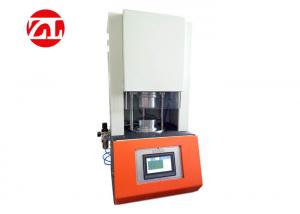
GB/T16584 Digital Temperature Controller No Rotor Rubber Rheometer
This advanced rubber testing machine is designed according to GB/T16584 standards for testing vulcanization characteristics of rubber using no-rotor rheometer technology. It complies with ISO6502 standards and can measure critical parameters including T10, T30, T50, T60, and T90 according to Italian standards.
Applications
The machine tests unvulcanized rubber characteristics to determine optimal vulcanization time. It features imported intelligent digital temperature controllers for easy adjustment, wide temperature range, high accuracy, excellent stability, and reproducibility. Computer-controlled operation enables data storage, printing, and software-based curve comparison and amplification.
Main Functions
- Computer-controlled operation with direct parameter setting and control
- Real-time display of vulcanization curves and temperature curves
- Comprehensive test result storage and management
- Comparison of different test results with color-coded displays
- Single-chip microcomputer control system integration
- Automatic temperature control with PID parameter correction
- Real-time torque signal detection and display
- Automatic calculation and printing of vulcanization curves and process parameters
- Audible prompts for various operational stages
Software Features
- Testing standardization: GB/T16584, ISO6502:1991, and ASTMD5289-95
- Flexible specimen information management with customizable material numbering
- Dynamic testing time modification during operation
- Automatic graph curve scale optimization (Auto Scale)
- Multi-material data comparison capabilities
- Real-time curve adjustment based on test data parameters
Working Principle
The rubber sample is placed in an almost entirely enclosed mold cavity maintained at test temperature. The mold cavity consists of two parts, with the lower part performing small linear reciprocating movements (swing oscillation). This oscillatory shear produces strain in the specimen, and the reaction torque of the mold cavity is measured. This torque depends on the rubber's shear modulus. As curing begins, the shear modulus increases, and the computer system displays and records the torque in real-time, generating a torque-time curve known as the curing curve.
Technical Documentation
Technical Specifications
| Parameter | Specification |
| Model | Without Rotor Rheometer Rubber Testing Machine |
| Temperature Range | Room temperature to 200°C |
| Temperature Accuracy | ≤ ±0.3°C |
| Temperature Resolution | 0.1°C |
| Torque Range | 0-5N.M, 0-10N.M, 0-20N.M |
| Torque Resolution | 0.001NM |
| Motor Rotating Speed | 100 times / min |
| Rotor Range | 4 settings: 25, 50, 100, 200lbs per inch |
| Die Cavity Frequency | 1.7Hz |
| Sway Angle | ±0.5°, ±1°, ±3° |
| Air Compression | 0.5Mpa--0.65MPa |
| Ambient Temperature | 0-35°C |
| Test Results | Date, time, temperature, vulcanization curve, temperature curve, ML, MH, ts1, ts2, t10, t50, Vc1, Vc2 |
| Dimensions | 131*56*62cm |
| Power Supply | Single phase, 220V±10%, 50Hz |
| Display System | Windows 7 + software |
| Weight | 250kg |